
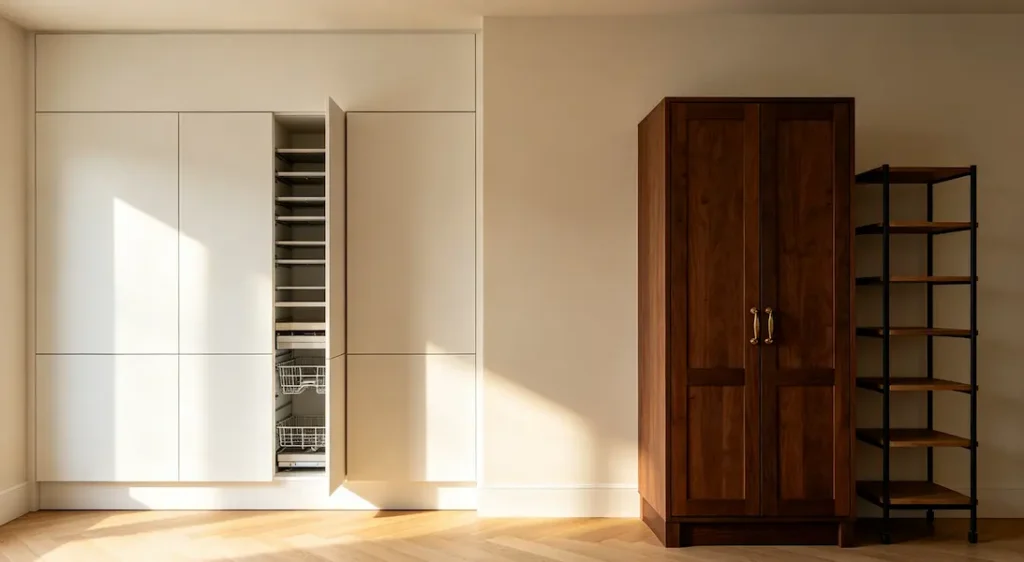
Kitchen storage is easy to underestimate until you run out of it. A pantry that is too small can leave appliances on the countertop, while poorly planned cabinets can create wasted corners and hard-to-reach shelves. At the same time, choosing a permanent storage system can make a future kitchen change much more difficult.
That is why the choice between built-in and freestanding kitchen storage deserves more attention than simply deciding which style looks better.
Built-in storage can be customized around your kitchen’s dimensions and integrated into the overall cabinetry. Freestanding storage, including standalone pantry cabinets, can add useful capacity without requiring a major renovation. A third option—a hybrid approach—can combine both.
So which is right for you?
The answer depends on how much space you have, how much storage you need, your budget, installation requirements, and how likely your needs are to change. This guide compares the options so you can make a practical purchasing decision.
Built-In vs Freestanding Kitchen Storage: What’s the Difference?
The most important distinction is how the storage relates to the kitchen itself.
1. Built-In Kitchen Storage
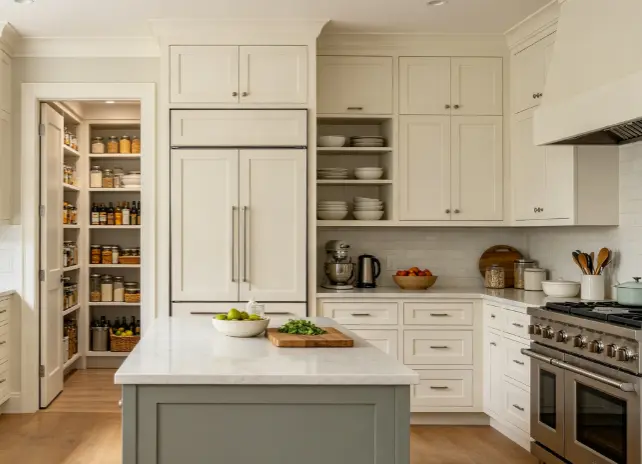
Built-in storage is permanently installed and designed as part of the kitchen. It may include:
- Built-in pantry cabinets
- Floor-to-ceiling cabinetry
- Integrated kitchen cabinets
- Custom pantry systems
- Walk-in pantries
A built-in pantry cabinet is different from a walk-in pantry. The former is a cabinet integrated into the kitchen, while the latter is a dedicated room or enclosed storage space that you can physically enter.
In general, built-in storage prioritizes permanence, integration, space optimization, and customization.
2. Freestanding Kitchen Storage
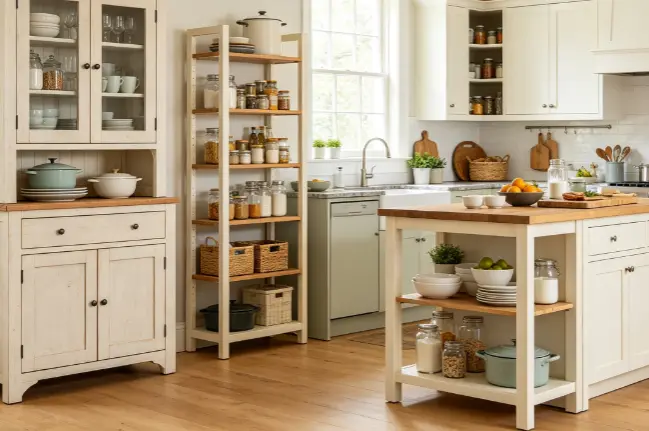
Freestanding storage is an independent furniture or cabinet unit rather than a permanent component of the kitchen structure.
Examples include:
- Freestanding pantry cabinets
- Standalone shelving
- Furniture-style kitchen cabinets
- Movable storage units
- Portable kitchen islands
The main advantages are flexibility, easier installation, and easier replacement or relocation.
3. Built-In vs Freestanding at a Glance
| Factor | Built-In | Freestanding |
|---|---|---|
| Installation | Usually more involved | Generally simpler |
| Space efficiency | Excellent when custom-designed | Depends on available standard sizes |
| Storage potential | Highly customizable | Depends on the product |
| Cost | Can involve higher project costs | Usually less renovation complexity |
| Flexibility | Limited after installation | Easier to rearrange or replace |
| Customization | Extensive | Limited to product design |
| Appearance | Seamless and integrated | Furniture-like or contrasting |
| Mobility | Permanent | Generally movable |
| Best suited for | Long-term renovations | Flexible storage upgrades |
These are general differences rather than absolute rules. A well-designed freestanding pantry can provide substantial storage, while a poorly planned built-in can still waste space.
Space Fit & Storage Capacity: Which Makes Better Use of Your Kitchen?
The first question to ask is not “Which looks better?” It is:
Will this storage actually fit my kitchen and provide enough usable capacity?
1. Where Built-In Storage Has an Advantage
Custom cabinetry can be designed around the exact dimensions of the room. This is especially valuable when you have an awkward corner, unused wall area, or limited floor space.
A built-in pantry can potentially:
- Extend from floor to ceiling
- Use wall space more completely
- Fit unusual dimensions
- Reduce gaps between storage units
- Integrate with surrounding cabinetry
- Create dedicated pantry zones
A walk-in pantry provides another way to increase capacity by dedicating an entire area to food and kitchen storage.
As a general reference, walk-in pantry dimensions commonly fall around the 4- to 5-foot range for width, with depth varying according to the layout. Angi, for example, gives a general range of 4–5 feet wide and 3–5 feet deep for walk-in pantry closets, while other design guidance recommends allowing sufficient aisle clearance and shelf depth rather than relying on a single “standard” size.
This is important because a pantry’s total square footage does not automatically equal usable storage. Shelf depth and circulation space also matter.
2. Where Freestanding Storage Has an Advantage
A freestanding pantry cabinet can add storage without changing the kitchen’s structure.
This makes it useful when you have an open section of wall but do not want to:
- Remove existing cabinets
- Rebuild walls
- Redesign the entire kitchen
- Commit to permanent cabinetry
For example, a current HOMCOM freestanding pantry cabinet measures 31.25 inches wide × 13 inches deep × 64 inches high and has five storage levels, including three adjustable shelves. Its listed overall weight capacity is 88 lb, with an 11 lb capacity per shelf.
That gives shoppers a concrete idea of what a relatively narrow standalone pantry can provide: roughly 13 inches of floor depth while adding six-plus feet of vertical storage.
Another HOMCOM model measures 31.5 inches wide × 17 inches deep × 63 inches high and combines 14 tiers. The manufacturer demonstrates individual shelf and spice-rack limits specified separately.
These examples also show why shoppers should compare more than exterior dimensions. Two pantry cabinets occupying similar floor areas can have very different internal storage configurations.
3. Which Is Better for a Small Kitchen?
There is no automatic winner.
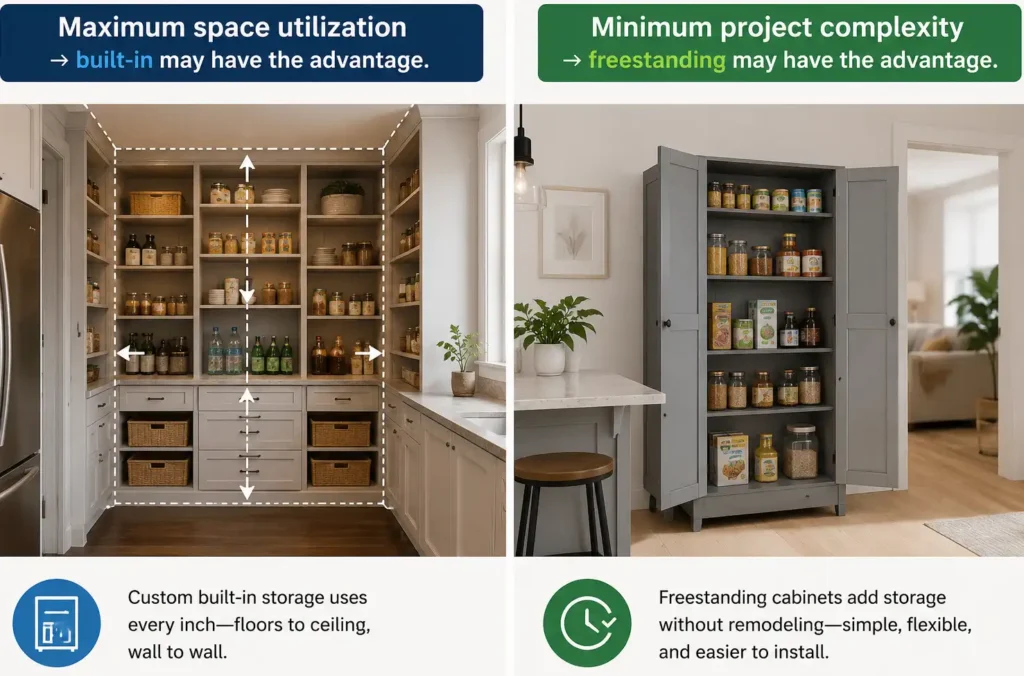
If your priority is using every available inch, custom built-in storage may be the stronger option.
If your priority is adding useful storage without remodeling, a freestanding pantry may make more sense.
The decision comes down to two competing priorities:
Internal organization matters just as much. A smaller freestanding pantry with adjustable shelves and well-planned compartments may be more useful than a larger cabinet with fixed shelves that do not match the items you actually store.
Cost & Installation: What Does Each Option Really Cost?
The cheapest-looking option is not necessarily the cheapest project.
When comparing kitchen storage, separate the product cost from the total installation or renovation cost.
1. Freestanding Pantry Costs
A freestanding pantry may involve:
- Product price
- Delivery
- Assembly
- Optional wall anchoring
- Organizational accessories
The major advantage is that the existing kitchen usually does not need to be structurally redesigned.
2. Built-In Pantry Costs
Built-in storage can introduce additional expenses such as:
- Cabinet materials
- Design
- Measuring
- Custom fabrication
- Professional installation
- Labor
- Structural modifications
- Electrical or plumbing changes where necessary
- Finishing work
A walk-in pantry can involve additional work for shelving, lighting, flooring, walls, and doors.
This is why comparing a $500 freestanding cabinet with the purchase price of a custom cabinet does not necessarily tell you which project is cheaper. The built-in option may involve an entire installation project rather than a single furniture purchase.
Pull-out shelving provides another example. A roll-out shelf may cost approximately $200–$500, depending on its construction and quality. Five shelves could therefore exceed $1,000 before other project costs. Treat these figures as reference ranges rather than universal prices.
The key question is:
Am I comparing the price of a product or the total cost of creating the storage solution?
For a simple storage upgrade, freestanding storage can reduce project complexity. For a major renovation where cabinetry work is already planned, adding custom pantry storage may be easier to justify.
Flexibility, Lifestyle & Future Changes
Storage should fit not only your kitchen but also your plans for the home.
1. Why Freestanding Storage Works Well for Flexible Lifestyles
A freestanding pantry can generally be easier to:
- Rearrange
- Replace
- Move to another room
- Take to another home
- Adapt to changing storage needs
- Use in a rental property
Can a freestanding pantry be moved later?
Generally, yes, provided the unit can be safely handled. Emptying a tall cabinet before moving it is essential, and safety anchoring should be restored when the cabinet is placed in its new location.
This flexibility can be especially valuable for renters or homeowners who expect to move.
A freestanding pantry also allows you to test a storage configuration before committing to permanent cabinetry. If your family grows or your kitchen habits change, replacing a standalone cabinet is generally a simpler project than rebuilding integrated cabinetry.
2. When Built-In Storage Makes More Sense
Built-in storage is more appropriate when your kitchen plan is already relatively permanent.
It can make sense if:
- You are completing a major remodel
- You plan to stay in the home for many years
- You want custom dimensions
- You want the pantry integrated with surrounding cabinets
- You have unusual spaces that standard cabinets cannot use efficiently
The decision can be framed around two questions:
“Do I want my kitchen designed specifically for me for the next 10 years?”
or:
“Do I want storage that can change when my needs change?”
The first points toward built-in storage. The second points toward freestanding storage.
Neither approach automatically adds resale value. The quality, design, condition, and suitability of the overall kitchen matter more than simply whether the storage is built in.
Design, Customization & Organization
Storage is also part of the kitchen’s visual design.
1. Built-In: Seamless and Customized
Built-in cabinetry can create a coordinated appearance because its dimensions and finishes can be planned alongside the rest of the kitchen.
Possible advantages include:
- Matching cabinet finishes
- Floor-to-ceiling designs
- Integrated hardware
- Custom dimensions
- Consistent visual lines
- A minimalist appearance
It can also be designed around fixed kitchen elements such as walls, outlets, and other constraints, subject to appropriate professional planning.
2. Freestanding: Furniture-Like and Expressive
Freestanding storage can deliberately look different from the surrounding cabinets.
A pantry cabinet can introduce:
- Contrasting colors
- Wood finishes
- Vintage-inspired details
- Furniture-style doors
- Decorative hardware
- An eclectic appearance
This can be useful if you want the kitchen to feel less uniform.
The same principle applies to organization. The exterior style may attract you to a pantry cabinet, but the interior determines how useful it will be.
Look for:
- Adjustable shelves
- Pull-out shelves
- Deep drawers
- Door storage
- Vertical dividers
- Appliance storage
- Accessible shelf heights
- Appropriate weight capacities
For example, the 72.5-inch HOMCOM pantry combines adjustable shelving with a drawer and enclosed cabinet storage, while another model uses door shelves to create additional storage zones.
This illustrates an important point:
Storage efficiency is not determined only by whether a cabinet is built-in or freestanding. Internal organization can have just as much impact.
A smaller pantry with adjustable shelves may outperform a larger but poorly configured cabinet because the storage is easier to access and better suited to the items being stored.
Which Should You Choose: Built-In, Freestanding or Hybrid?
Once you compare space, cost, installation, flexibility, and organization, the decision becomes more straightforward.
1. Choose Built-In or Walk-In If:
- You are already planning a major kitchen renovation.
- Maximum space utilization is your priority.
- Your kitchen has unusual dimensions.
- You want extensive customization.
- A seamless appearance matters.
- You expect to stay in the home long term.
- You are comfortable with a larger upfront project.
2. Choose Freestanding or Standalone If:
- You want additional storage without remodeling.
- You want to keep project complexity low.
- You are renting.
- You may move in the future.
- You want to rearrange your kitchen.
- You prefer furniture-style storage.
- You want easier replacement.
- You need additional pantry capacity quickly.
3. Consider a Hybrid If:
- You want permanent storage but still value flexibility.
- You want built-in perimeter cabinetry with a movable island.
- You want a custom pantry cabinet combined with freestanding shelving.
- You want integrated storage for everyday items and standalone storage for overflow.
3. Three Practical Decision Scenarios
Example scenario 1: A small kitchen renovation
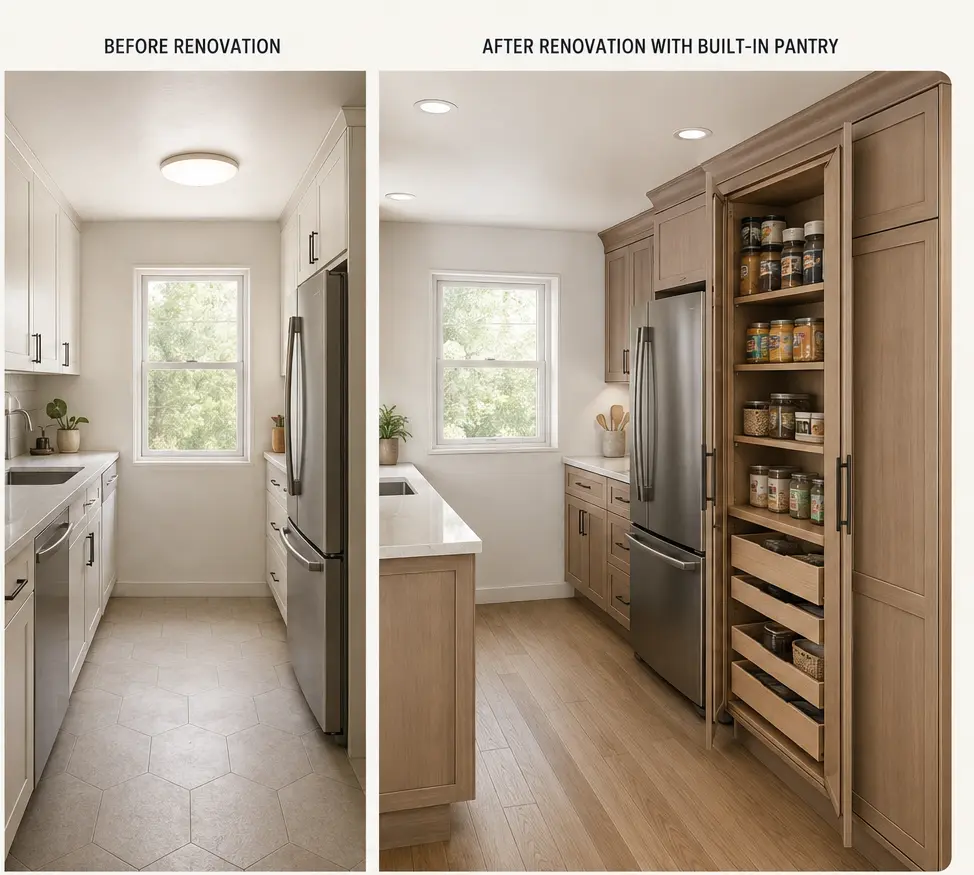
A homeowner has limited wall space and is already replacing the kitchen cabinets. Their priority is maximum storage within the existing footprint. A built-in pantry is likely to make more sense because custom dimensions can be incorporated into the renovation.
Example scenario 2: A rental kitchen
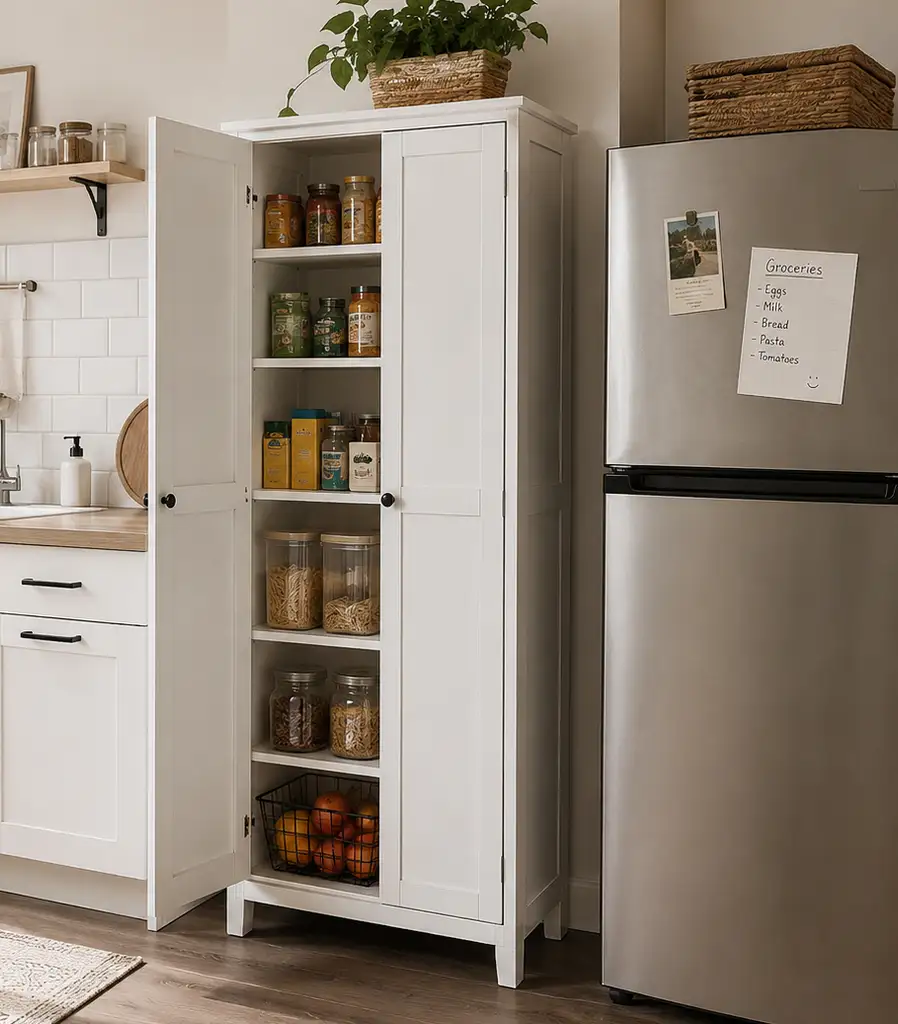
A renter needs additional food storage but cannot make permanent changes to the kitchen. A freestanding pantry cabinet is the more practical choice because it can add vertical storage without requiring structural remodeling.
Example scenario 3: A long-term homeowner
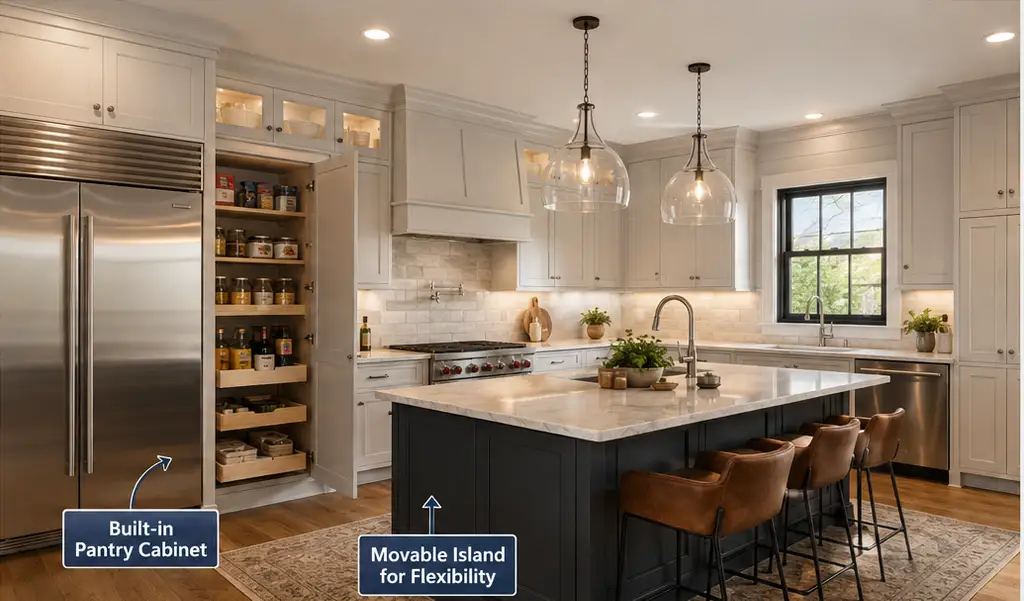
A homeowner is remodeling a large kitchen and expects to stay for many years. They want a cohesive appearance and extensive storage customization. Built-in cabinetry may be worth the additional project complexity, while a movable island or standalone cabinet can still provide flexibility where needed.
These are hypothetical scenarios rather than published case studies. The best solution will depend on the actual kitchen dimensions, budget, and storage requirements.
Final Decision Checklist
Before buying a pantry cabinet or committing to built-in storage, ask yourself:
- How much usable space do I actually have?
- How much storage capacity do I need?
- What is my total budget, including installation?
- Am I willing to undertake a renovation?
- How important is future flexibility?
- How long do I expect to stay in the home?
- Do I prefer seamless cabinetry or furniture-like flexibility?
The simplest way to remember the trade-off is:
Built-in = integration, permanence and customization.
Freestanding = flexibility, simpler changes and easier installation.
Hybrid = a balance between the two.
If you are already remodeling and want to maximize every inch, built-in pantry storage can be a strong long-term solution. If you need additional kitchen pantry storage without taking on a major renovation, a well-designed freestanding pantry cabinet can provide substantial vertical storage with far less project complexity.
The most important thing is to evaluate the storage itself—not just its appearance. Compare dimensions, usable shelf space, adjustability, weight capacity, assembly requirements, and installation needs before you buy.
Once you know how much space you have, how much you need to store, and how permanent you want the solution to be, choosing between built-in, freestanding, and hybrid kitchen storage becomes much easier.
FAQs
1. What are the pros and cons of freestanding cabinets?
Freestanding cabinets are flexible, relatively easy to install, and can add storage without requiring a major kitchen renovation. They can also be moved, replaced, or rearranged as your needs change, making them particularly useful for renters or homeowners who may move in the future. However, standard-size units may leave gaps or unused space, and they may not provide the same level of customization or seamless integration as built-in cabinetry.
2. What are the pros and cons of a cabinet pantry versus a walk-in pantry?
A cabinet pantry takes up less floor space and can provide substantial storage within the existing kitchen layout, making it a practical choice for smaller kitchens. A walk-in pantry offers more dedicated storage space and can accommodate shelving, larger items, and multiple storage zones, but it requires additional floor space and usually involves greater planning and installation costs. The better option depends on your available space, storage needs, and renovation budget.
3. Are freestanding pantry cabinets a good choice for small kitchens?
Yes. A freestanding pantry cabinet can be a practical way to add vertical storage without remodeling the kitchen. Look for a unit with dimensions that fit your available wall space, adjustable shelves, and an efficient internal layout. However, if maximizing every inch of an unusually shaped or very compact kitchen is the priority, a custom built-in pantry may make better use of the available space.
4. Can a freestanding pantry cabinet be moved?
Generally, yes. One of the main advantages of a freestanding pantry cabinet is that it can usually be relocated, replaced, or moved to another room or home. Before moving one, empty the cabinet and follow the manufacturer’s handling and anchoring instructions. Tall or heavy units should also be properly secured against tipping when placed in their new location.