
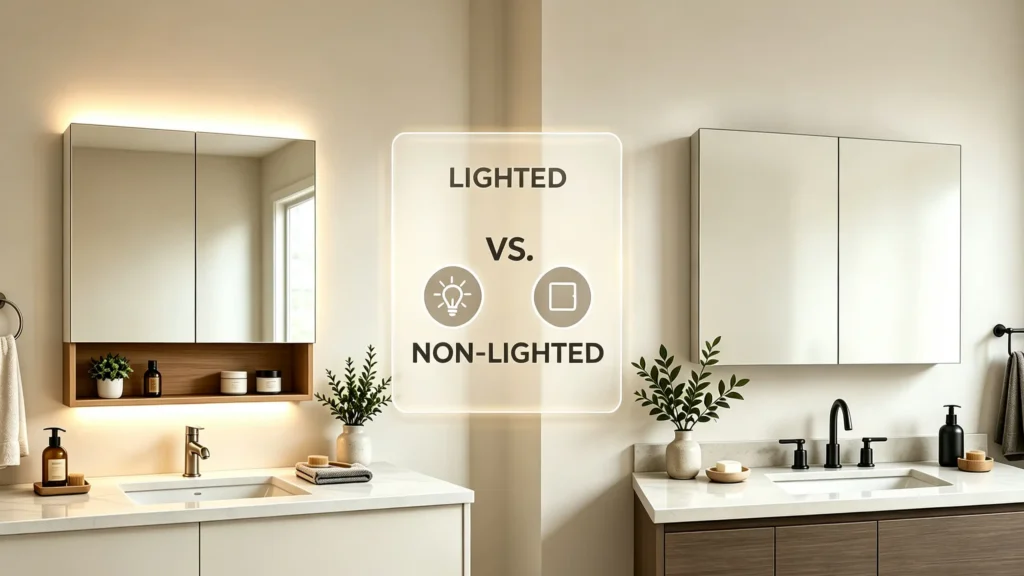
If your bathroom already has good vanity lighting, a medicine cabinet with built-in LEDs may seem unnecessary. But in a dim bathroom, an integrated light can provide useful task lighting while adding a cleaner, more modern look.
The better choice depends on more than appearance. Your existing lighting, storage needs, bathroom size, installation options, and the way you use the space can all affect whether a lighted or non-lighted medicine cabinet makes more sense.
This guide compares the two options and explains what to consider before choosing one for your bathroom.
Lighted vs. Non-Lighted Medicine Cabinets: What’s the Difference?
The basic difference is simple: a lighted medicine cabinet combines mirrored storage with integrated lighting, while a non-lighted medicine cabinet provides storage and reflection without built-in illumination.
| Feature | Lighted Medicine Cabinet | Non-Lighted Medicine Cabinet |
|---|---|---|
| Mirrored surface | Yes | Yes |
| Concealed storage | Yes | Yes |
| Integrated lighting | Yes | No |
| Additional task lighting | May provide it | Requires separate lighting |
| Anti-fog function | Available on some models | Usually requires a separate solution |
| Installation | May require electrical connection | Generally simpler |
| Best for | Bathrooms needing additional lighting and storage | Bathrooms with sufficient existing lighting |
A lighted cabinet can combine several bathroom functions in one wall-mounted fixture. A non-lighted cabinet gives you more flexibility to choose your own vanity or wall lighting separately.
Neither option is automatically better. The right choice depends on what your bathroom already has and what you want the cabinet to accomplish.
Do You Actually Need a Lighted Medicine Cabinet?
The most useful question is not whether lighted cabinets have more features, but whether integrated lighting solves a real problem in your bathroom.
Choose a Lighted Cabinet If:
- Your vanity area is poorly lit.
- You want additional light for shaving, makeup, or other grooming tasks.
- You prefer a streamlined look with fewer separate fixtures.
- You like the option of adjustable lighting or dimming.
- You want to combine lighting and storage in one fixture.
- You are remodeling and can plan the electrical installation accordingly.
Integrated lighting can be particularly useful when the existing ceiling light creates shadows around your face. A well-positioned lighted cabinet may provide more useful illumination at the vanity.
A Non-Lighted Cabinet May Be Better If:
- Your vanity already has effective task lighting.
- You prefer decorative sconces or a separate lighting design.
- You want a simpler installation.
- Your budget is better spent on storage or other bathroom improvements.
- You do not need additional illumination around the mirror.
A non-lighted cabinet is not a lower-quality choice simply because it lacks LEDs. If your bathroom already provides good, even lighting, adding another light source may offer little practical benefit.
The key is to choose based on your bathroom’s lighting needs rather than the number of features a cabinet offers.
Choose the Right Type of Integrated Lighting
If you decide that a lighted medicine cabinet is worthwhile, the next question is how the light should be positioned.
Front-Lit Cabinets
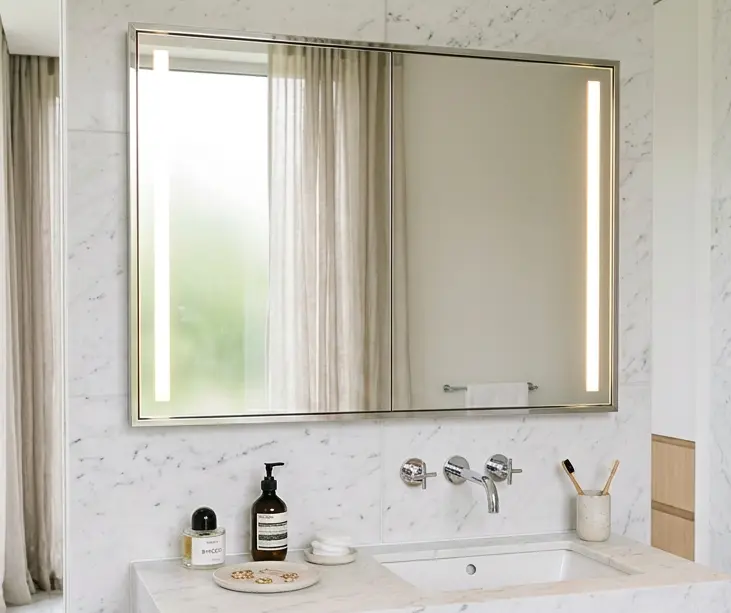
Front-lit cabinets place LEDs around or near the front of the mirror.
Because the light is directed toward the user, this configuration can be useful for:
- Makeup application
- Shaving
- Hair styling
- Other close-up grooming tasks
The important consideration is not simply brightness. Look for even illumination that reduces harsh shadows.
Backlit Cabinets
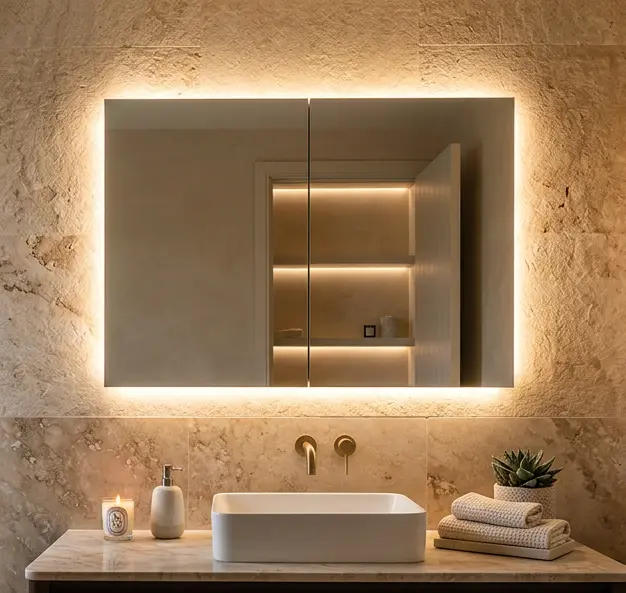
Backlit cabinets position LEDs behind the mirror, creating a glow around its edges.
This produces a softer, more atmospheric effect and can give the bathroom a spa-like appearance. However, backlighting alone may not provide the same task-lighting benefits as direct front lighting.
Dual-Lit Cabinets
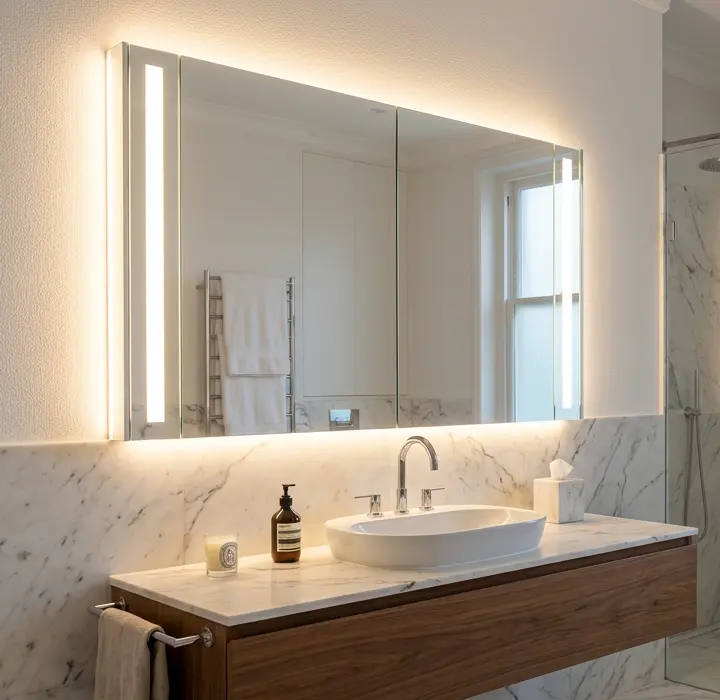
Some cabinets combine front and back lighting.
This can provide both functional illumination for grooming and softer ambient light for the rest of the bathroom.
If a cabinet offers multiple lighting modes, check the actual product specifications rather than assuming that every model provides the same performance.
A Common Mistake: Assuming Brighter Is Always Better
More light does not automatically mean better bathroom lighting.
A very bright light can create glare or feel uncomfortable, while poorly distributed light can still leave shadows.
When comparing lighted medicine cabinets, consider light distribution, brightness control, color rendering, and color temperature rather than brightness alone.
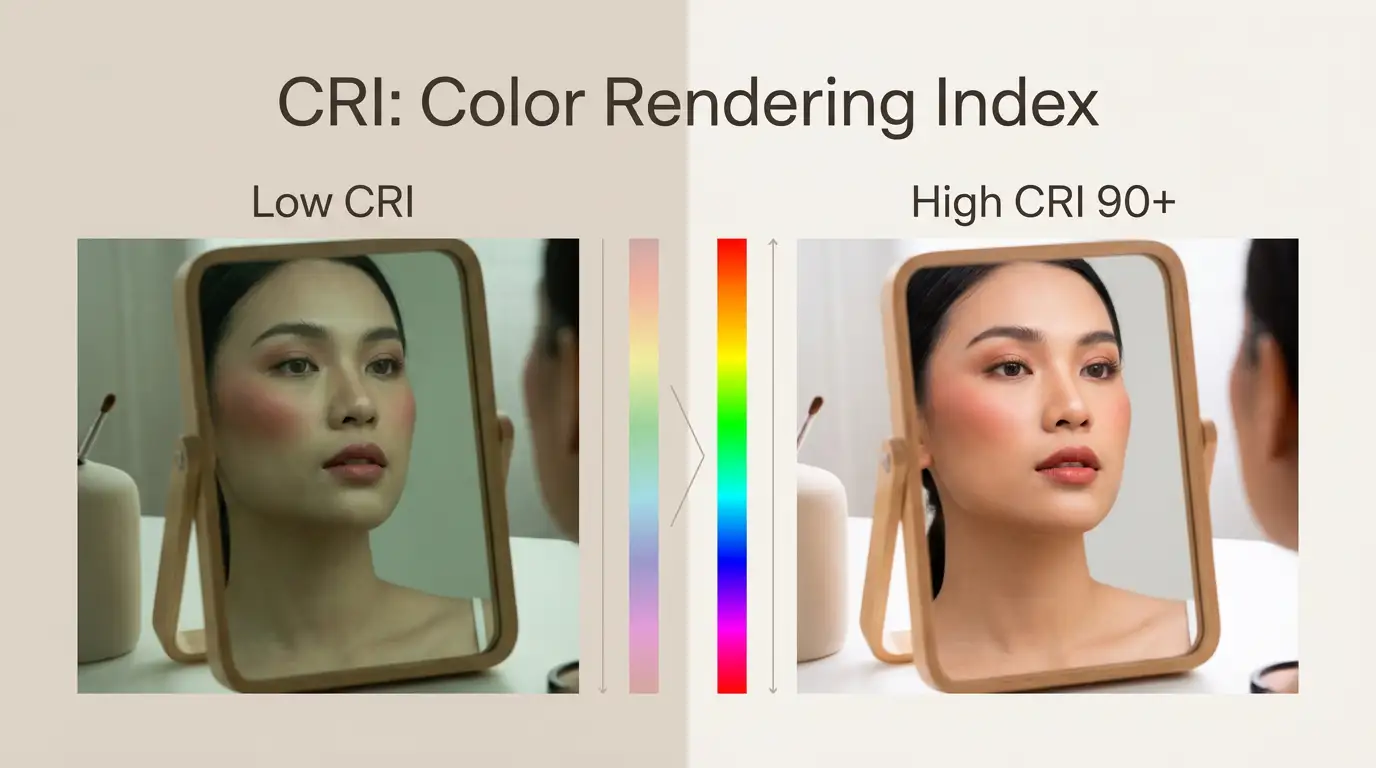
For example, a cabinet rated at CRI 90+ may provide more accurate color rendering than a lower-CRI option, which can be particularly useful for makeup and grooming.
Look Beyond Lighting: Practical Features That Matter
Lighting is only one part of a medicine cabinet’s functionality. Several non-lighting features can affect everyday convenience.
Anti-Fog Function
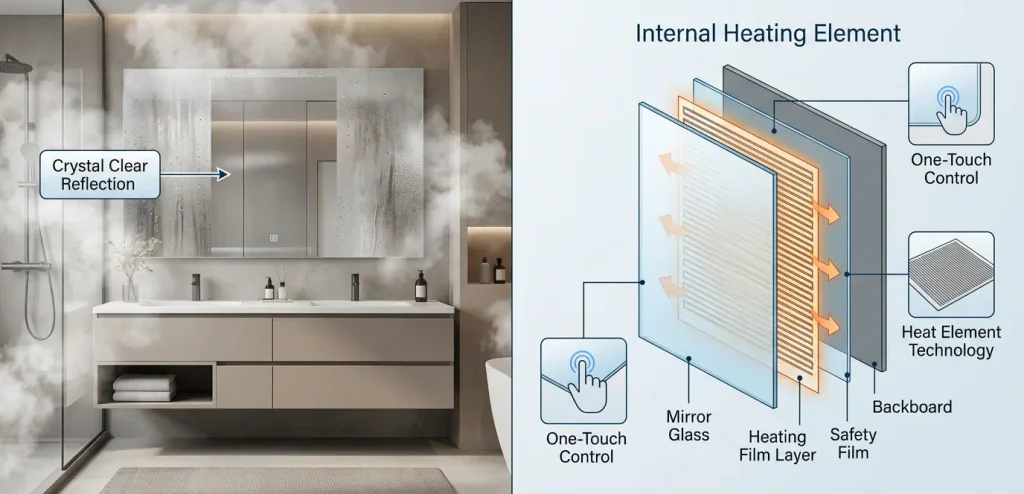
A built-in defogging system can help keep the mirror usable after a hot shower.
This can be especially convenient in bathrooms with poor ventilation or frequent condensation.
If anti-fog performance is important to you, check whether the cabinet includes a dedicated defogging function and how it is controlled.
Storage and Shelving
Storage is one of the biggest advantages of a medicine cabinet over a standard bathroom mirror.
Consider what you actually need to store:
- Skincare products
- Medicines
- Toothbrushes and dental supplies
- Razors
- Cosmetics
- Small grooming accessories
Adjustable shelves can make it easier to accommodate products of different heights.
You do not necessarily need the largest cabinet available. The goal is to gain useful storage without making the vanity area feel crowded.
Outlets and USB Ports
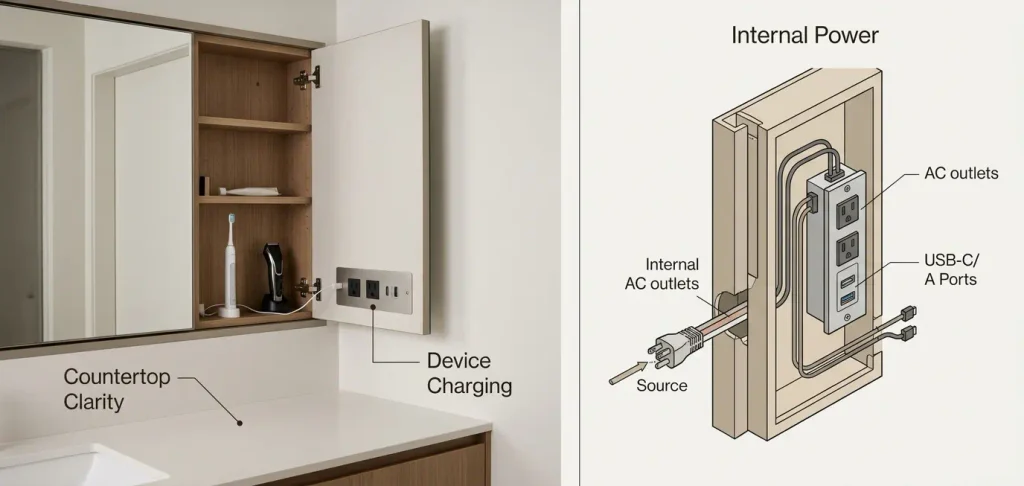
Some lighted medicine cabinets include integrated electrical outlets or USB charging ports.
These can be useful for charging items such as electric toothbrushes or grooming devices while keeping them off the countertop.
However, this is an optional convenience rather than a basic requirement. If your bathroom already has accessible outlets, it may not be a deciding factor.
Consider Installation and Available Space Together
Before buying a medicine cabinet, check both where it can be installed and how much space it will occupy.
Recessed Installation
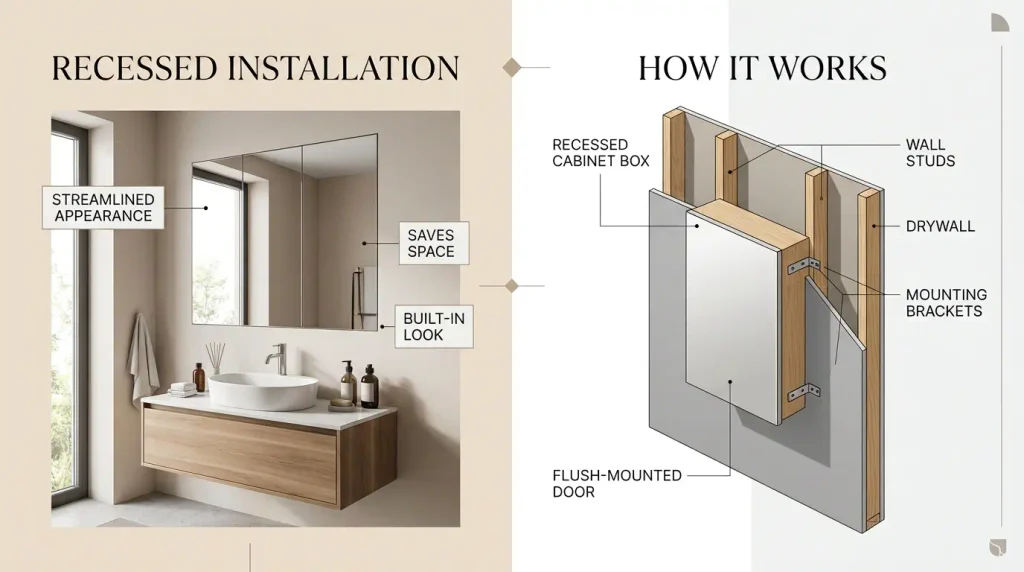
A recessed cabinet sits partly or fully inside the wall.
Advantages include:
- A more streamlined appearance
- Less projection into the bathroom
- A clean, built-in look
However, installation can be more complicated because the wall needs to accommodate the cabinet.
Surface-Mounted Installation
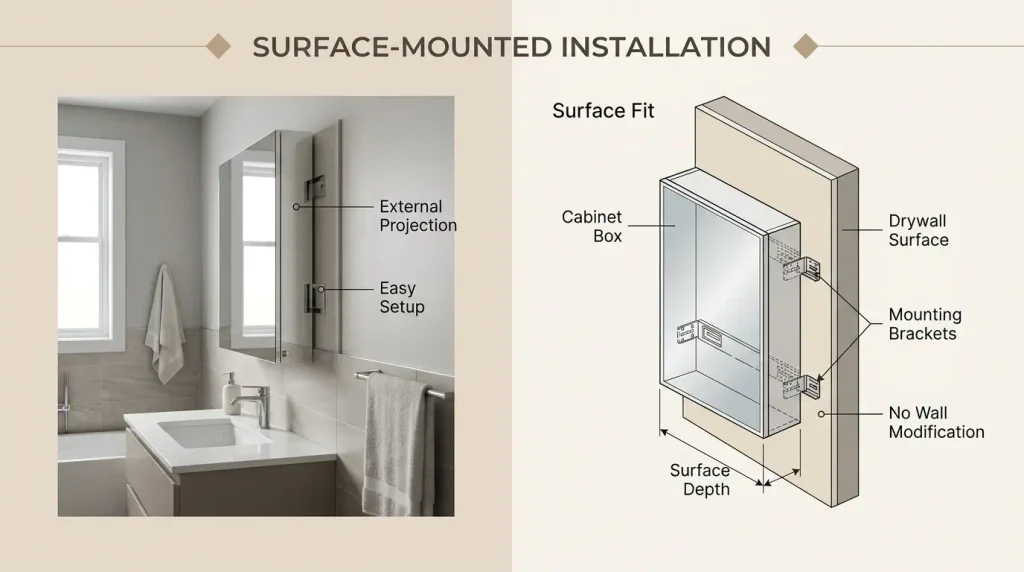
A surface-mounted cabinet attaches directly to the wall.
It can be more practical when you do not want to modify the wall structure, but the cabinet will project farther into the room.
This matters particularly in narrow bathrooms.
Check These Measurements Before Buying
Measure:
- Available wall width
- Available wall height
- Vanity width
- Distance from the sink
- Door and cabinet clearance
- Available wall depth for recessed installation
- Electrical access if choosing a lighted model
The cabinet should also be proportionate to the vanity. A very large cabinet can overwhelm a small vanity, while one that is too small may provide less useful storage and visual balance.
Match the Cabinet to Your Bathroom’s Existing Lighting
Your existing lighting should influence the decision.
If you already have well-positioned sconces or effective vanity lighting on both sides of the mirror, a non-lighted medicine cabinet may provide everything you need.
If the bathroom relies mainly on an overhead fixture, however, additional lighting around the mirror may improve visibility for grooming.
Think about where the light comes from and where shadows fall, not simply how many light fixtures are installed.
You should also consider the overall atmosphere you want:
- Functional and bright: prioritize even task lighting.
- Warm and relaxing: softer, dimmable lighting may be preferable.
- Flexible: adjustable color temperature or multiple lighting modes can accommodate different activities.
Lighted vs. Non-Lighted: Which One Should You Choose?
Use this quick guide if you are still deciding:
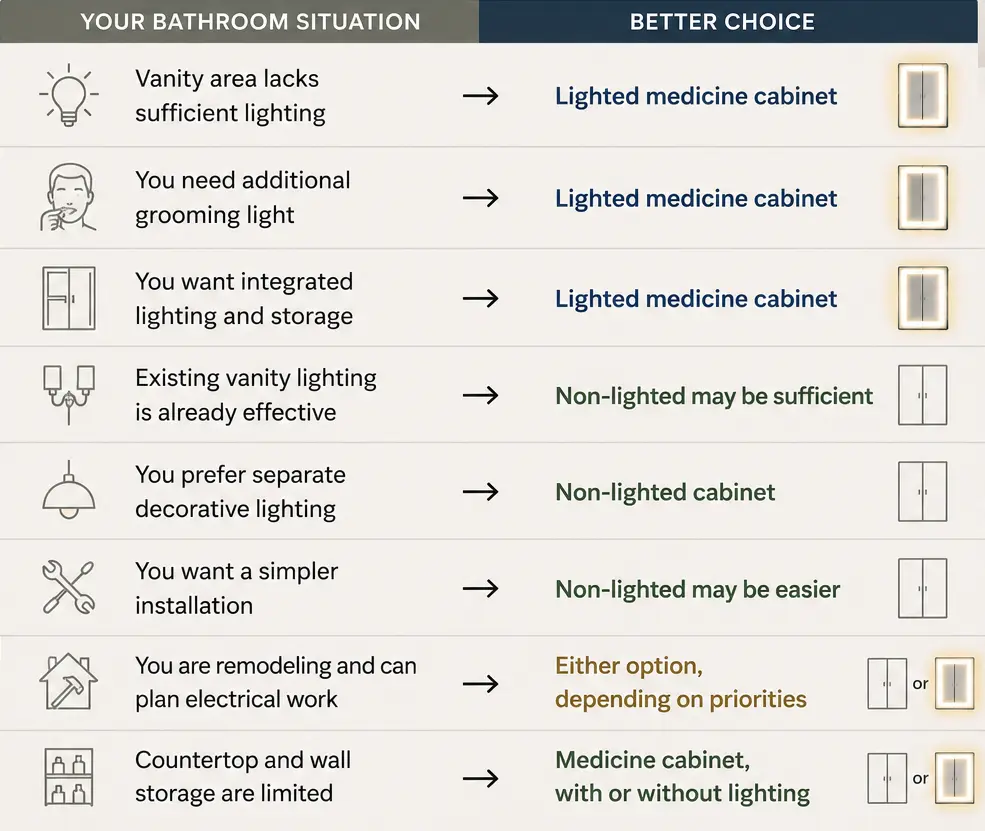
The decision ultimately comes down to what your bathroom is missing.
If you need both storage and better mirror lighting, a lighted medicine cabinet can solve two problems with one fixture. If storage is the priority and your lighting is already good, a non-lighted cabinet may provide better value and more design flexibility.
A Simple Buying Checklist
Before choosing a medicine cabinet, ask yourself:
- Lighting: Do I actually need integrated lighting?
- Use: Will I use the mirror mainly for grooming, or is it primarily decorative?
- Storage: How much concealed storage do I need?
- Features: Would anti-fog, outlets, or USB charging make a meaningful difference?
- Size: Does the cabinet fit the wall and work proportionately with the vanity?
- Installation: Is recessed or surface mounting more practical for my bathroom?
- Electrical: Is electrical access available if I choose an integrated-lit model?
- Style: Does the cabinet work with the existing bathroom design?
- Maintenance: Can the surfaces and features be cleaned and maintained easily?
A cabinet with more features is not necessarily the better choice. Focus on the features that solve problems you actually have.
Final Takeaway
The choice between a lighted and non-lighted medicine cabinet is ultimately a question of function, not simply appearance.
Choose a lighted medicine cabinet when you need additional illumination around the vanity and want to combine lighting with concealed storage. Consider a non-lighted cabinet when your existing lighting already works well or when you prefer to control the bathroom lighting separately.
Before making a decision, evaluate your existing lighting, storage needs, available wall space, installation requirements, and the features you are most likely to use.
If you decide that integrated lighting is right for your bathroom, compare cabinets based on the lighting quality, storage capacity, installation method, and practical features that fit your needs—rather than simply choosing the model with the longest feature list.
FAQs
1. Are lighted medicine cabinets worth it?
A lighted medicine cabinet can be worth it if your bathroom needs better vanity lighting and additional storage in one fixture. If you already have effective task lighting, a non-lighted medicine cabinet may offer better value.
2. What are the disadvantages of a lighted medicine cabinet?
Potential disadvantages include a higher upfront cost, more complicated installation when electrical wiring is required, and additional components that may eventually need maintenance or replacement. The benefits are greater when you actually need integrated lighting.
3. Is a front-lit or backlit medicine cabinet better?
Front-lit cabinets generally provide more direct illumination for grooming tasks, while backlit cabinets create a softer, more atmospheric glow. If you want both, a dual-lit model can provide a combination of task and ambient lighting.
4. Do lighted medicine cabinets prevent fogging?
Not necessarily. Some lighted medicine cabinets include a built-in anti-fog or defogging function, but integrated lighting alone does not prevent condensation. Check the product specifications to confirm whether an anti-fog feature is included.
5. How long do LED lights in medicine cabinets last?
LED lighting is generally designed for long-term use, but the actual lifespan varies by product and components. Check the manufacturer’s stated LED lifespan and warranty rather than assuming all lighted medicine cabinets have the same service life.