
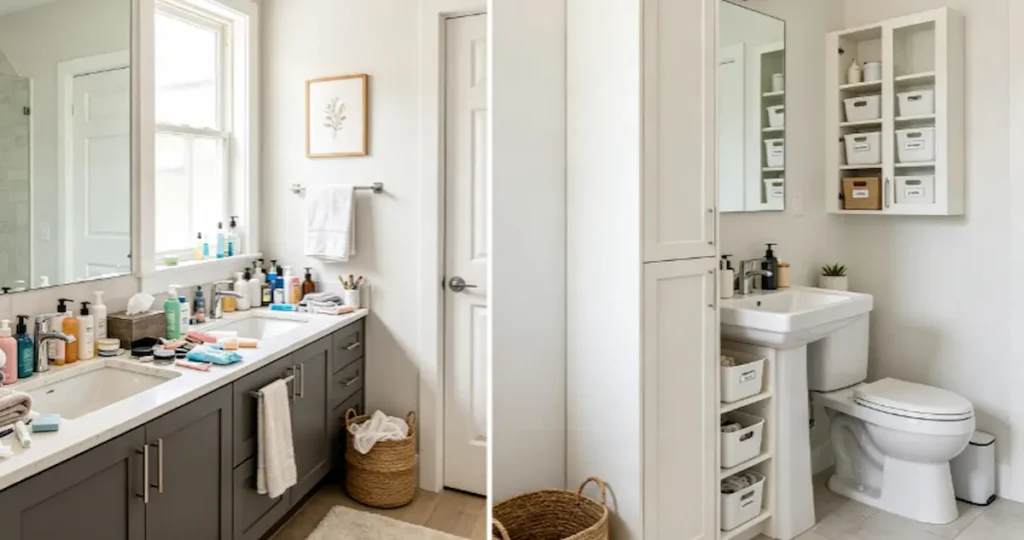
Quick Answer:The best way to organize a bathroom is to start with what you already have, then build a storage system around the way you use the room. First, remove expired, duplicated and unused products. Next, identify where storage can fit without interfering with fixtures or movement. Measure the available space before choosing furniture, then match each storage type to the items you need to keep.
For everyday organization, frequently used products should be easy to reach, while backups and occasional-use items can be stored elsewhere. Open shelves, drawers, cabinets and baskets each work better for different types of belongings.
The goal is not to add as much storage as possible. It is to create a bathroom where everything has a practical place and the items you use most often are easy to find and put away.
1. Declutter Your Bathroom Before Adding More Storage
Before choosing new bathroom storage, start by deciding what actually needs to stay.
A bathroom can feel overcrowded even when it has enough storage simply because too many products are competing for the same space. Adding another cabinet may increase capacity, but it will not solve the problem if expired, duplicated or unused items are still taking up room.
Go through your bathroom and separate products into a few simple groups:
| Category | Examples | Organization Approach |
|---|---|---|
| Daily use | Toothbrushes, skincare, hand soap | Keep within easy reach |
| Regular use | Haircare, shaving products, cosmetics | Store in accessible drawers or cabinets |
| Backup supplies | Spare toiletries, toilet paper | Keep together in secondary storage |
| Occasional use | Guest towels, seasonal items | Store in less frequently accessed areas |
| Unused items | Empty, expired or unwanted products | Remove from the bathroom |
This first step is important because it establishes how much storage you actually need.
For example, if you discover that several shelves are filled with products you rarely use, replacing the cabinet with a larger one may simply create more space for unnecessary items.
A simple question to ask
Before buying additional storage, ask:
Do I need more storage, or do I need less to store?
Once unnecessary items are removed, you can see which storage problems actually remain.
2. Identify the Best Storage Areas in Your Bathroom
After decluttering, look at the physical layout of the bathroom.
This is where you decide where storage should go.
Instead of treating every empty area as an opportunity for another cabinet, consider how each location relates to the fixtures and activities around it.
Around the vanity
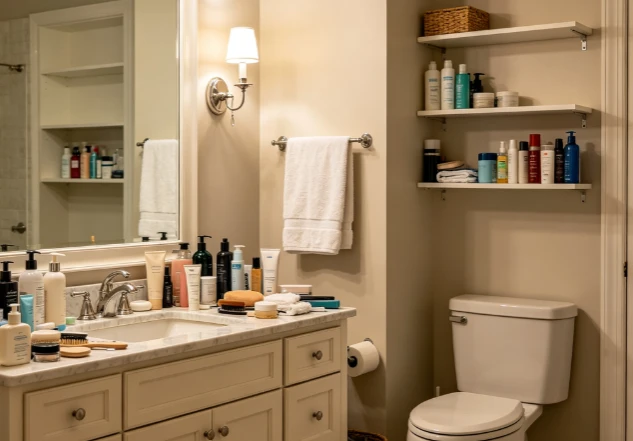
The vanity area is usually associated with everyday grooming, so storage here is particularly useful for products that are used frequently.
Drawers, small organizers and cabinet compartments can keep everyday items close without leaving everything on the countertop.
Under the sink
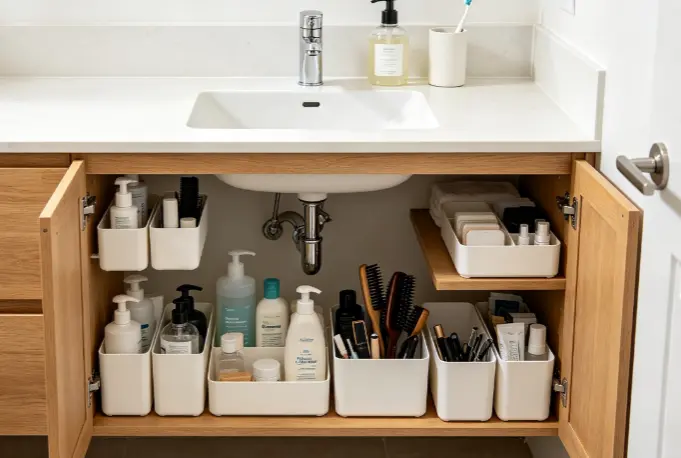
The space beneath the sink can be useful for products that do not need to remain visible.
Depending on the plumbing layout, this area may accommodate:
- Cleaning supplies
- Spare toiletries
- Haircare products
- Toilet paper
- Storage baskets
The exact solution depends on the shape and position of the plumbing.
Above the toilet
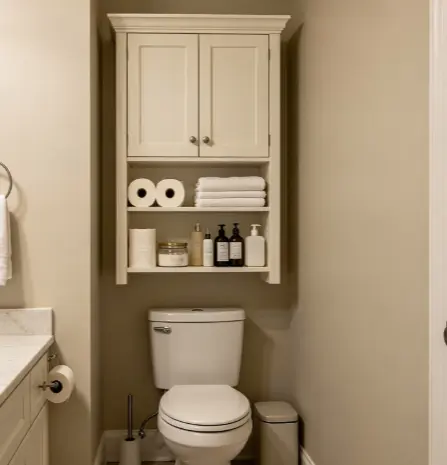
The wall area above the toilet can sometimes provide useful storage without occupying additional floor area.
Suitable shelving or an appropriately sized storage unit can hold items such as towels or toilet paper.
However, the storage should not interfere with the toilet, nearby fixtures or normal movement through the room.
Corners and narrow gaps
Small gaps can sometimes accommodate narrow storage furniture or organizers.
A tall, slim cabinet may be useful when the available floor area is narrow but there is sufficient vertical clearance.
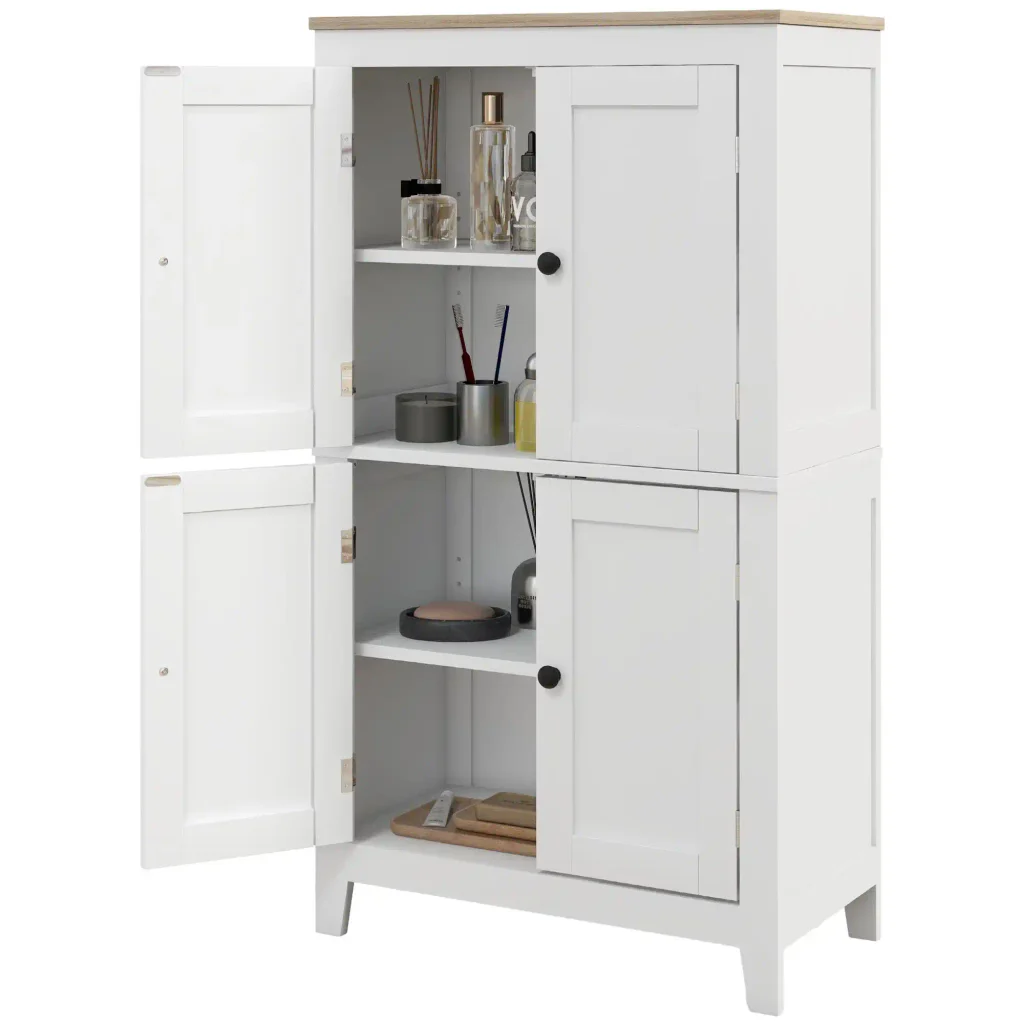
For example, the original article included a HOMCOM narrow bathroom cabinet measuring approximately 11.8″ W × 11.8″ D × 66.9″ H. If this product remains in the published article, its current dimensions and specifications should be verified against the live product page.
The key principle
The important point is not simply to “use vertical space.”
It is to match the location of storage with the way that area of the bathroom is used.
For example:
- Near the vanity → everyday grooming products
- Under the sink → cleaning supplies and backups
- Above the toilet → towels or toilet paper
- Narrow gaps → slim storage for smaller categories
- Less accessible areas → occasional-use products
This prevents the same storage principle from having to be repeated throughout the rest of the article.
3. Measure the Space Before Choosing Bathroom Storage
Once you know where storage could go, measure those areas before choosing furniture.
A storage unit can have plenty of capacity and still be unsuitable if its dimensions interfere with doors, drawers, fixtures or movement.
Measure:
- Available width
- Available depth
- Maximum height
- Door and drawer clearance
- Distance from nearby fixtures
- Walking space
- Skirting boards or other obstacles
- Plumbing locations
- Windows, switches and ventilation points where relevant
Think beyond the furniture footprint
For example, a cabinet may physically fit between a wall and the vanity, but that does not automatically mean it will work well.
Ask:
- Can the doors open fully?
- Can drawers extend without hitting another fixture?
- Is there enough room to stand in front of it?
- Does its depth make the passage feel narrow?
- Can you still access nearby fixtures comfortably?
Professional bathroom planning considers storage together with the room’s overall layout. When choosing or positioning a bathroom cabinet, make sure it does not obstruct movement or reduce the usable space around bathroom fixtures. NKBA guidance recommends allowing approximately 30 inches (762 mm) of clear space in front of bathroom fixtures, while frequently used items should ideally be stored between 15 and 48 inches (381–1219 mm) above the floor for easier access.[2] These measurements can help determine whether a storage unit is suitable for a particular location and whether its shelves or compartments are positioned conveniently.
Use the three-check rule
Before purchasing a storage unit, check:
Available space → Furniture dimensions → Storage requirements
All three need to work together.
A cabinet that fits the room but cannot accommodate the items you need is not an effective storage solution.
Likewise, a cabinet with excellent internal capacity is not useful if it makes the bathroom difficult to move around.
4. Match Storage to the Items You Need to Organize
After deciding where storage can go, decide what each storage area is actually for.
Different bathroom products have different organization requirements.
| Bathroom Item | Suitable Storage | Main Consideration |
|---|---|---|
| Towels | Shelves or linen storage | Easy access and folding space |
| Toiletries | Drawers or compartments | Small items are easier to group |
| Cosmetics | Vanity drawers or organizers | Frequently used products should be easy to reach |
| Haircare products | Shelves, drawers or cabinets | Keep bottles grouped together |
| Toilet paper | Cabinet or dedicated shelf | Store spare rolls together |
| Cleaning supplies | Closed cabinet | Keeps utility products separate |
| Backup toiletries | Secondary cabinet or higher shelf | Does not need daily access |
| Guest supplies | Dedicated shelf or cabinet area | Keeps them together and easy to find |
The key distinction is between capacity and organization.
A large cabinet does not necessarily make a bathroom easier to organize. If everything is stacked together, finding one small product can still be difficult.
A smaller storage unit with appropriate shelves, compartments or drawers may be more useful because its internal configuration matches the items being stored.
Organize by frequency of use
A simple hierarchy works well:
Daily-use items → easiest access
Regular-use items → convenient storage
Backup items → secondary storage
Occasional-use items → less accessible storage
This approach also supports more accessible bathroom planning. NKBA guidance recommends providing adequate, accessible storage for toiletries, bath linens, grooming products and other bathroom essentials near the point of use.[2] In practice, this means placing frequently used items close to the vanity, shower or bath, so users can reach them easily without unnecessary movement.
5. Choose the Right Type of Bathroom Storage
Once you know where the storage will go and what it needs to hold, decide which type of storage is most appropriate.
Open shelving
Open shelves make products easy to see and reach.
They can work well for:
- Towels
- Baskets
- Frequently used products
- Decorative storage containers
The drawback is that everything remains visible, so too many products can make the room look cluttered.
Closed cabinets
Closed cabinets hide products from view and can create a cleaner appearance.
They are useful for:
- Cleaning products
- Backup toiletries
- Less attractive packaging
- Personal-care products you do not need to display
Drawers
Drawers are particularly useful for smaller items.
They can separate categories such as:
- Cosmetics
- Grooming products
- Hair accessories
- Small toiletries
Baskets and containers
Baskets can group smaller products inside larger cabinets or on open shelving.
They can be especially useful when several similar products need to be kept together.
Combine different storage types
You do not need to choose only one.
For example:
Open shelf → towels
Drawer → everyday toiletries
Closed cabinet → backup supplies
Basket → smaller products
The goal is to make the storage system correspond to how the bathroom is actually used.
6. Consider Safety, Stability and the Bathroom Environment
Bathroom storage needs to be practical, but it also needs to be appropriate for its intended use.
When evaluating a cabinet, shelf or storage unit, consider:
- Stability
- Construction
- Intended use
- Material and finish
- Loading information
- Installation requirements
- Ease of cleaning
- Manufacturer care instructions
- Exposure to the bathroom environment
Check stability and loading information
Tall or heavily loaded storage furniture deserves particular attention.
BS EN 14749:2016 covers domestic and kitchen storage units, including bathroom storage units and other domestic storage furniture. It sets out safety requirements and test methods relating to aspects such as stability and loading.[1]
However, citing this standard does not confirm that a particular bathroom cabinet has been tested or complies with it. When choosing storage furniture, check the manufacturer’s stated load limits, installation requirements and fixing instructions, especially for tall, wall-mounted or heavily loaded units.
Consider the bathroom environment
Do not assume that all furniture materials will perform in exactly the same way in a bathroom.
Check the manufacturer’s information for:
- Material
- Finish
- Intended environment
- Cleaning instructions
- Moisture-related care requirements
Avoid describing a product as “waterproof” or “completely moisture-proof” unless the manufacturer specifically provides that claim.
7. Adapt the Organization System to Your Bathroom and Household
The basic storage principles remain the same, but the amount and type of storage required can change significantly depending on who uses the bathroom.
This section is therefore about user needs—not another list of space-saving techniques.
Small Bathroom
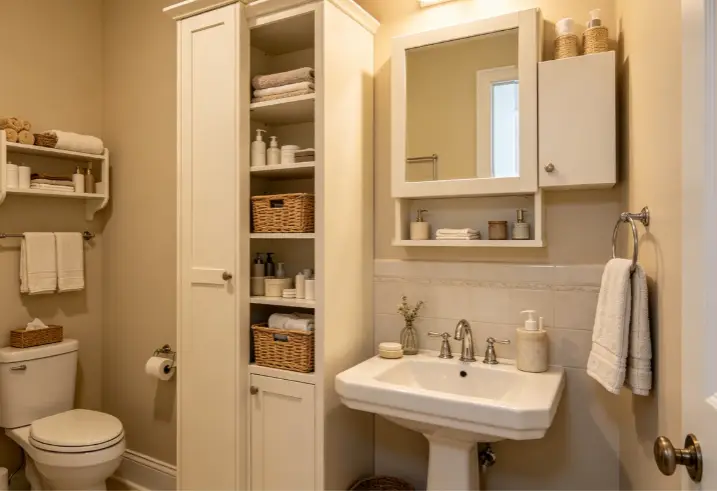
A small bathroom may require a more selective storage system because there is less room for multiple furniture pieces.
Prioritize the items you use most often and avoid storing unnecessary backups in the main bathroom.
The objective is to make the existing storage work efficiently rather than simply adding more furniture.
Family Bathroom
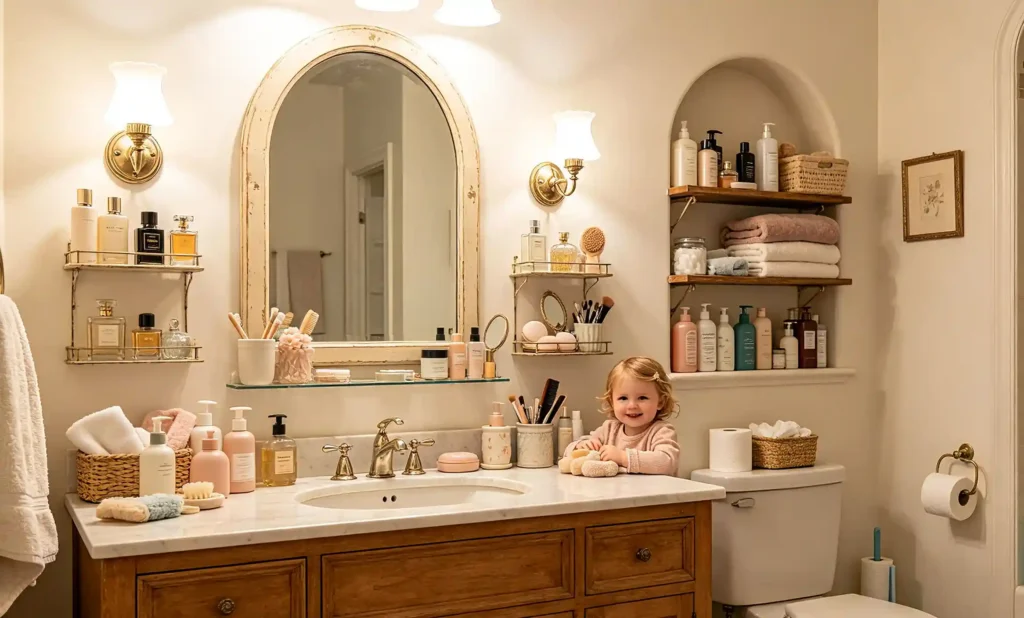
A family bathroom may need to accommodate several people’s belongings.
Separate storage by person or category where practical.
For example:
- Adult toiletries
- Children’s products
- Towels
- Haircare
- Grooming products
- Backup supplies
Clear categories can make shared storage easier to maintain.
Guest Bathroom
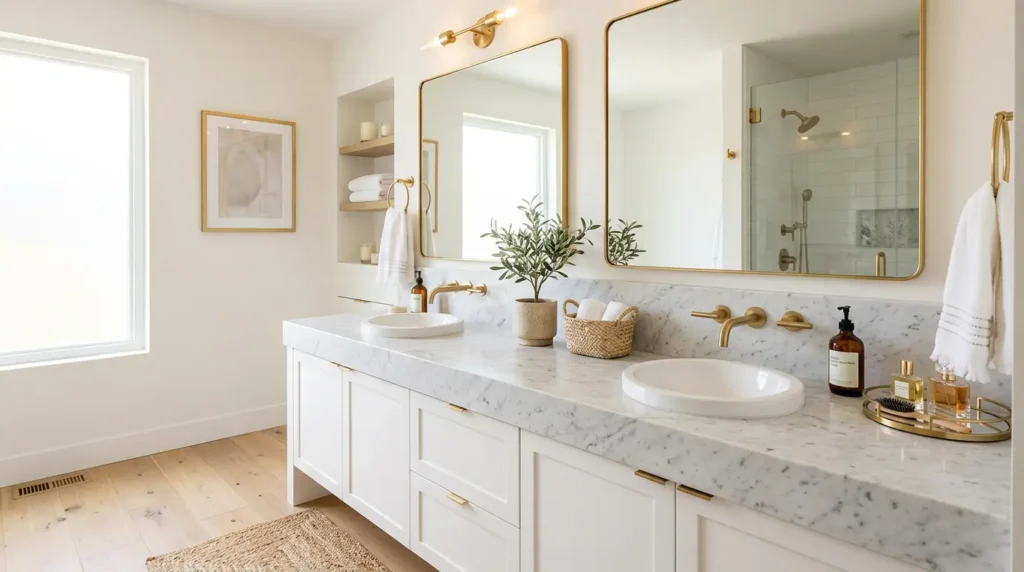
A guest bathroom generally requires fewer personal products.
Focus on essentials such as:
- Hand soap
- Fresh towels
- Toilet paper
- Basic toiletries
Keeping these items together makes the bathroom easier for guests to use.
Rental Bathroom
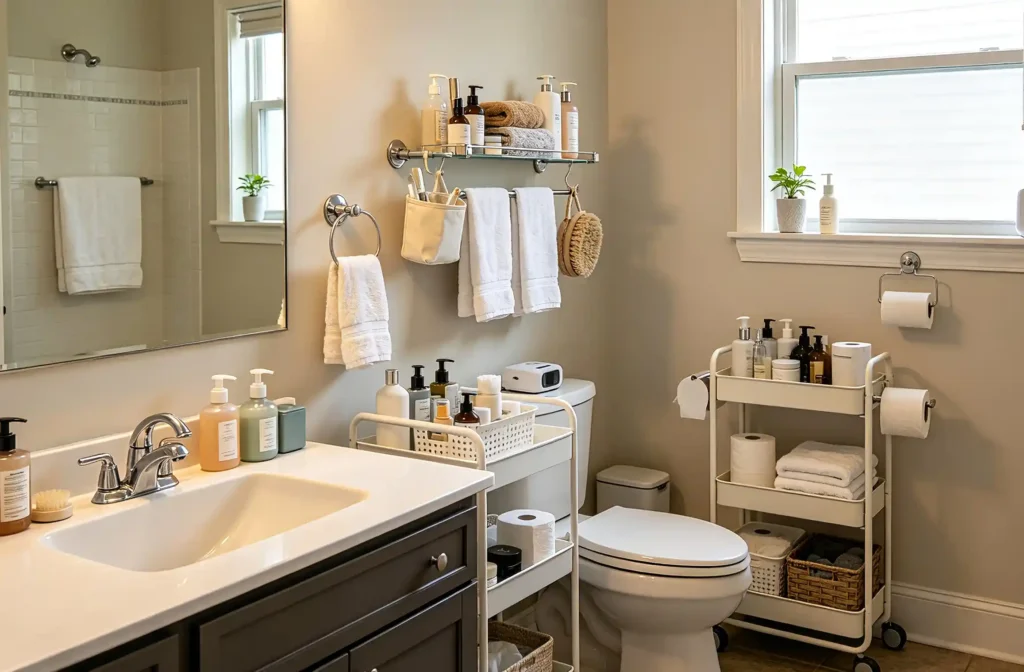
Renters may have restrictions on drilling, permanent installation or structural changes.
In this situation, freestanding or removable storage can provide additional organization without requiring major modifications.
The important consideration is not simply whether a product is removable, but whether it works within the existing bathroom layout and any applicable rental restrictions.
8. Put the Principles Into Practice With a Real Storage Example
A useful way to evaluate bathroom storage is to apply the previous steps to an actual product.
Imagine a bathroom with:
- Limited floor space
- Several categories of toiletries
- A need for additional concealed storage
- No suitable built-in cabinet
The decision process would be:
1. Declutter
Remove products that no longer need to be stored.
2. Identify the available location
Find a suitable area without disrupting the main bathroom fixtures.
3. Measure the space
Check the maximum width, depth and height.
4. Identify storage requirements
Determine whether the cabinet needs shelves, drawers, compartments or a combination.
5. Check the product specifications
Review dimensions, materials, loading information and intended use.
Only after these steps should you compare actual products.
9. Keep Your Bathroom Organized Over Time
An organization system only works if it is easy to maintain.
You do not need to reorganize the entire bathroom every week. A few simple habits can prevent clutter from gradually returning.
Return products to the same place
If frequently used items have consistent storage locations, they are easier to find and put away.
Review products periodically
Remove empty, expired or unused products before they accumulate.
Keep categories together
If spare toiletries are stored in one location, you can see what you already have before buying more.
Reassess when your needs change
A bathroom organization system may need to change when:
- A household gains another user
- Children become older
- Daily routines change
- Storage requirements increase
- A rental bathroom becomes a long-term home
Follow furniture care instructions
Clean cabinets, shelves and organizers according to the manufacturer’s recommendations.
For products with specific installation, loading or maintenance instructions, follow the manufacturer’s guidance rather than applying the same care method to every storage product.
Key Takeaways
Effective bathroom organization starts with using what you already have more intelligently, rather than simply adding more furniture.
Start by decluttering and grouping your belongings. Then use practical locations around the bathroom, choose storage that fits both the room and your routine, and keep everyday products close to where they are used. Finally, make the system simple enough to maintain.
The best organization system is one that makes everyday tasks easier while keeping unnecessary clutter out of sight.
FAQs
1. What are some good organizing ideas for a small bathroom?
Maximize vertical space with wall‑mounted shelves, over‑the‑toilet units and hanging organizers to free up counter space. Use stackable bins and drawer dividers to group toiletries. Opt for multi‑purpose accessories, and declutter regularly by removing unused items to keep limited space tidy and functional.
2. What are some effective ways to organize my bathroom vanity?
Use drawer dividers, small trays and labeled containers to separate makeup, skincare products and hair tools. Store frequently‑used items on the vanity top in decorative canisters, while keeping less‑used supplies inside cabinets. Add under‑sink organizers to make full use of the awkward space beneath the sink.
3. How can I store things in a bathroom with no built‑in storage?
Lean on freestanding furniture such as narrow cabinets, rolling carts and open shelving units. Install no‑drill wall hooks, hanging baskets and over‑door organizers for towels and toiletries. Decorative baskets and caddies can hold essentials without permanent cabinet installation, perfect for rental bathrooms.
4. What are the latest trends in bathroom storage?
Popular modern trends include floating wall‑mounted vanities and open shelving for an airy look, hidden concealed storage to hide clutter, multi‑functional furniture, and natural‑material woven baskets. Custom niche recessed storage inside shower walls is also widely favored for seamless, space‑saving bathroom organization.